Updated 4 days ago
Solar inverters: pros and cons of string inverters vs. microinverters
Written by
Andy Sendy
Find out what solar panels cost in your area
Solar inverters have one core function: convert the direct current (DC) solar panels generate into an alternating current (AC) used in your home. There are two main types of home solar inverters:
Microinverters attach to the back of each panel and are best for complex solar installations.
String inverters connect strings of panels in one central location and are best for simple installations.
Microinverters have become the most popular inverter option because they are compliant with National Electrical Code and safety standards. String inverters need to be paired with DC optimizers or rapid shutdown devices to be up to code.
There are pros and cons to each type of solar inverter, and the right one for you ultimately depends on your system design.
Solar inverter types
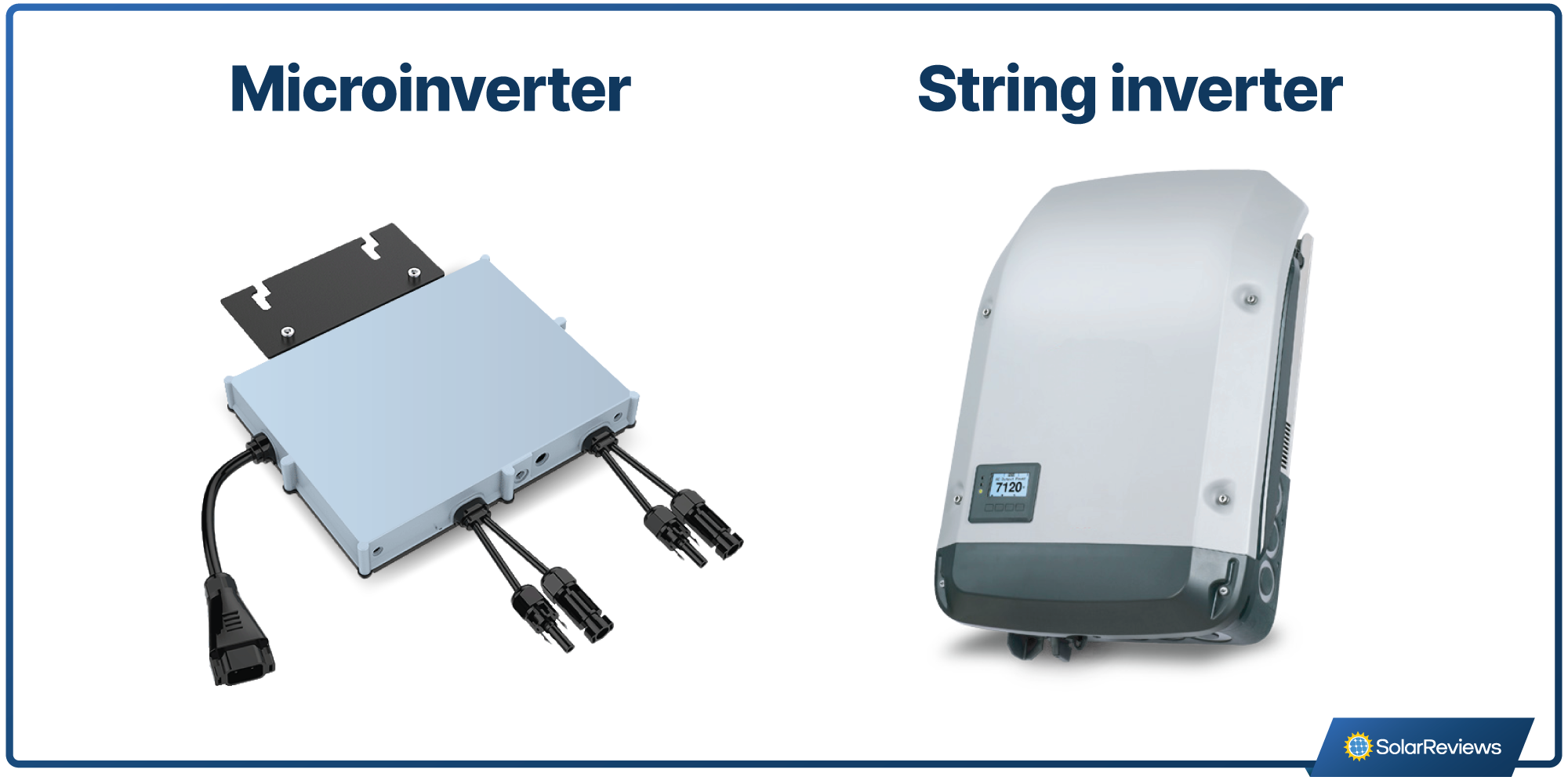
There are two main types of solar inverters for home solar installations:
String inverters
Microinverters
Each one converts energy from your solar panels into electricity your homes can use, but how they get it done is a bit different.
String inverters
A string inverter is installed on your home, typically close to your main service panel or electric meter. The electricity generated by a string of solar panels is sent to the inverter, where it’s converted to AC current and sent to your home appliances.
Because of how the solar panels are wired together, if there is an issue with one panel in the string, the energy production of all the panels strung together will be impacted. For example, if one panel in a string is shaded and produces less energy, all of the other panels in the string will match that shaded panel.
There is typically only one single string inverter installed for a residential solar installation, and they are very popular for solar systems installed on simple, unshaded roofs.
String inverters are often paired with DC power optimizers to meet electrical code standards. Power optimizers are attached to the back of each panel and track the panel’s peak output. The optimizers can then regulate voltage before the power gets sent to the string inverter, maximize the amount of energy the system produces, and reduce the impacts of shading.
Microinverters
Microinverters perform the same basic function as string inverters, except they are installed underneath each solar panel on your roof. Some microinverter models allow you to attach two or four panels to each unit.
With a microinverter, the DC to AC conversion is completed right at the back of the panel.
While standard string inverters will cap the electricity production of each panel by the lowest-producing panel in a string, microinverters don’t have this problem since they function in a parallel circuit.
A microinverter takes full advantage of the production of each individual panel. Each solar panel and microinverter combination can “do their best” and contribute as much power as they can. Microinverters work best for complex solar installations on multiple roof faces.
Hybrid inverters. Solar systems paired with battery storage may use a hybrid inverter that connects the panels, the battery, the grid, and your home together in one unit. Hybrid inverters are efficient and allow for a streamlined design. However, they are becoming less common as more batteries are being sold with built-in inverters.
Pros and cons of solar inverters
Every home solar panel system needs inverters to operate. But the right one for you depends on the system’s design. Let’s take a closer look at some of the advantages and disadvantages of each inverter type.
String inverter pros and cons
Pros
-
Easy to troubleshoot
-
Low cost
-
Simple system design
Cons
-
Efficiency in shade or single-panel issues
-
Difficult system expansion
-
10-year lifespan
-
Additional equipment needed for rapid-shutdown requirements
-
Inverter issue impacts entire system
One of the biggest benefits of string inverters is their simplicity. Often, if there is an issue with a solar system, it has to do with the inverter. With string inverters, there’s only one, so troubleshooting and repairing the issue is easy, and no one has to get on your roof to repair it.
String inverters are also cheaper than other inverter options, but keep in mind that you do often have to pair the system with optimizers or rapid shutdown devices, which will increase the cost.
The downside to string inverters is that issues with one panel can impact the energy production of the other panels it’s wired to, lowering how much electricity your home has to use and eating into your solar savings if not addressed right away. DC optimizers do help with this issue, but having to get additional equipment is a bit of a hassle. Also, if there is an issue with the string inverter, your whole system will be offline until it’s repaired.
Because of how the panels are wired together and the voltage requirements of string inverters, they aren’t the best choice for complex system designs that have panels on multiple roof faces and aren’t great if you try to add more solar panels in the future. Plus, string inverters have a short lifespan of 10 years — solar panels last for at least 25. So, you’ll likely have to replace your string inverter at least once.
Microinverter pros and cons
Pros
-
Meets rapid-shutdown requirements
-
Easy system expansion
-
Panel level monitoring
-
Individual panel performance doesn't impact others
-
25-year lifespan
-
Make it easier to add panels to an existing system
Cons
-
Difficult to repair
-
Expensive
-
More points of failure
Microinverters have quickly become the most popular choice for residential solar installations - and for good reason! They don’t require additional equipment to meet electrical code requirements, can be used for intricate system designs, and don’t have the same shading issues as string inverters. Because microinverters output AC power from each solar panel, it makes it easier to add more solar panels to an existing system. Microinverters also have a 25-year lifespan, so you don’t have to worry about getting them replaced after 10 years.
But, when there is an issue with microinverters, it can be difficult to repair. First, the defective microinverter has to be properly identified on your roof. Then, an installer needs to get up there, find, and fix it. This is much more difficult than troubleshooting a string inverter on the side of your house. The upside is that if there is an issue with one microinverter, the rest of the system can keep operating and powering your house with solar energy.
Also, there is exponentially more equipment used in a microinverter system than a string inverter system. This means there are more points of potential failure and a higher price tag.
What are the top solar inverter brands?
If you’re getting solar quotes, it’s highly likely that you’ll see one of two brands listed for inverters - Enphase or SolarEdge.
Enphase is far and away the number one choice for microinverters. Its products are trusted by installers nationwide, and the company has a good reputation when it comes to customer service. Regarding microinverters, we would stick with Enphase because of its reputation. You don’t want to cut corners when it comes to your inverters.
SolarEdge is one of the most popular choices for string inverters and DC optimizers. SolarEdge is another brand that has been around for a long time that installers feel comfortable working with. We have seen some reports of less-than-great customer service, but it’s not an accident that their systems are popular.
Learn more: Enphase vs. SolarEdge inverters
There are some other brands you may come across when looking at inverters, like:
SMA
GoodWe
Fronius
While not as popular, these are still trustworthy brands that can keep your solar system up and running.
Microinverters vs. string inverters: which is best for your home?
The right inverter for you ultimately depends on your home and the type of solar installation you get.
If you have a simple roof, your panels are only getting installed on one side of your home, and you don’t have a ton of issues with shading, we would recommend getting a string inverter and DC optimizers. The optimizers give you the benefit of maximizing your panel’s power production, but you still enjoy the ease of having just one inverter and the lower price point.
Microinverters are the better choice if your system design is more complex, like if you have panels on more than one roof plane. Also, if your panels receive partial shade throughout the day, you’ll definitely want to go with microinverters. It may be a slightly higher price in the end, but you’ll get more savings by maximizing each individual panel’s power production.
Key takeaways
-
Inverters convert DC electricity to AC electricity, which your home appliances use.
-
String inverters are standalone boxes ideally suited to unshaded solar panel arrays on roofs with uniform pitch.
-
Microinverters are affixed to the back of every solar panel and maximize the output of each solar panel independent of the production of any neighboring panel, making them smart to use on partially-shaded solar installations.
-
String inverters do not have native rapid shutoff capabilities on their own, whereas microinverters do.
-
String inverters, while more affordable, do not have panel-level monitoring capabilities and come with a shorter lifespan of 8 to 12 years.
Andy Sendy is a well-known and trusted figure within the solar industry with more than 15 years of experience. His video reviews of the leading brands of solar panels and home energy storage batteries are a must-watch each year for both homeowners and solar industry professionals alike. In 2021, an article he wrote about a clause in the Tesla solar panel rental contract caused Tesla to change this clause within days. He was the founder of Sola...
Learn more about Andy Sendy