Find out what solar panels cost in your area
Going solar is one of the best investments you can make – both for your wallet and the environment.
For those who own their own homes, the process of going solar is easy: they can install a solar panel system on their roof, and enjoy a great return on investment while producing clean energy.
Unfortunately, going solar is a lot less straightforward for those of us who live in an apartment complex or a rental home. But worry not: even without your own roof, you can still benefit from clean solar power — and possibly even reduce your electricity bills and carbon footprint in the process.
Options that allow renters to take advantage of solar power include:
Asking your landlord to install solar
Portable solar panels
Joining a community solar farm
Choosing your utility company’s green power rate plan
Below are some more details about each of these options.
Your top questions answered
Can I install solar panels in my apartment?
Yes, but only a small portable system that’ll fit on your balcony or another location with good sun exposure. These systems have a small power output, typically between 0.3 and 1.5 kWh per day.
Can I install solar panels on the roof of a rented home?
In theory, yes. But because installing solar panels is a significant property upgrade, it would require your landlord’s permission. But we wouldn’t recommend this; it doesn’t make sense to spend so much on a property that’s not yours. You're better off convincing your landlord to install the system instead.
Can I lease or rent solar panels for the home I’m renting?
No, only the homeowner can enter an agreement to lease or rent a solar power system. Furthermore, solar leases and rentals are designed to be long-term arrangements, so there’s a big financial penalty for removing the solar panels before the contract term is up.
1. Ask your landlord to install solar panels
This option is only relevant if you live in a rental home with a suitable roof.
If so, you can make your rental space green by convincing your landlord that they have a lot to gain from a solar installation.
To do this, request a meeting with your landlord and discuss the following points:
Homeowners can claim local and federal solar tax credits
In many states, they can claim solar property and sales tax exemptions
They can receive net metering credits for surplus energy generation
There are many solar financing options available for those who don’t have the upfront cash
Adding solar panels will also make their property worth more in the long run; analysis by Zillow shows that homes with solar technology are sold for 4.1% more on average.
Furthermore, as solar panels will lower energy bills for future occupants, it will be easier for the landlord to find new tenants after you leave.
We recommend that you do your research on the cost of solar panels in your area before you bring up the topic. This will help you enter the conversation better prepared.
2. Get a portable solar panel system
Portable solar panels have become progressively cheaper and more efficient in recent years. They are now a convenient source of power for those on the go and are widely used for things like RVs and camping, or even for a solar powered tiny house.
Since they can work anywhere with sun exposure, they can also work in an apartment or rental home. It’s easy to find small solar kits that can be set up on window sills, balcony railings, and banisters. Foldable solar panel kits come in handy if you live in a smaller space, as they are easy to store away.
These systems are typically rated between 100-300 watts and generate between 0.3 kWh and 1.5 kWh of electricity per day. This is enough to charge your smartphones, laptops, and even run some small appliances.
Pros of portable solar systems
An advantage to portable solar systems is that they come with, or can easily be connected to, attached battery storage. This means you’ll be able to use the power at any time of day.
Another advantage is that some of these tiny solar energy systems also qualify for the 30% federal tax credit, which will significantly reduce the cost of your purchase.
And the best part is that when you move to a new place you can take your solar system with you — which isn’t an easy option for homeowners with rooftop solar arrays!
Cons of portable solar systems
There are, however, a few downsides to portable solar systems you should be aware of.
Any portable system is going to produce less power than a ground-mounted or rooftop solar power system. That means you’ll need to continue using grid power to meet the majority of your power needs.
Furthermore, portable inverters and storage systems can get expensive; especially if you buy quality. Generally speaking, the smaller the solar system, the higher the cost per watt.
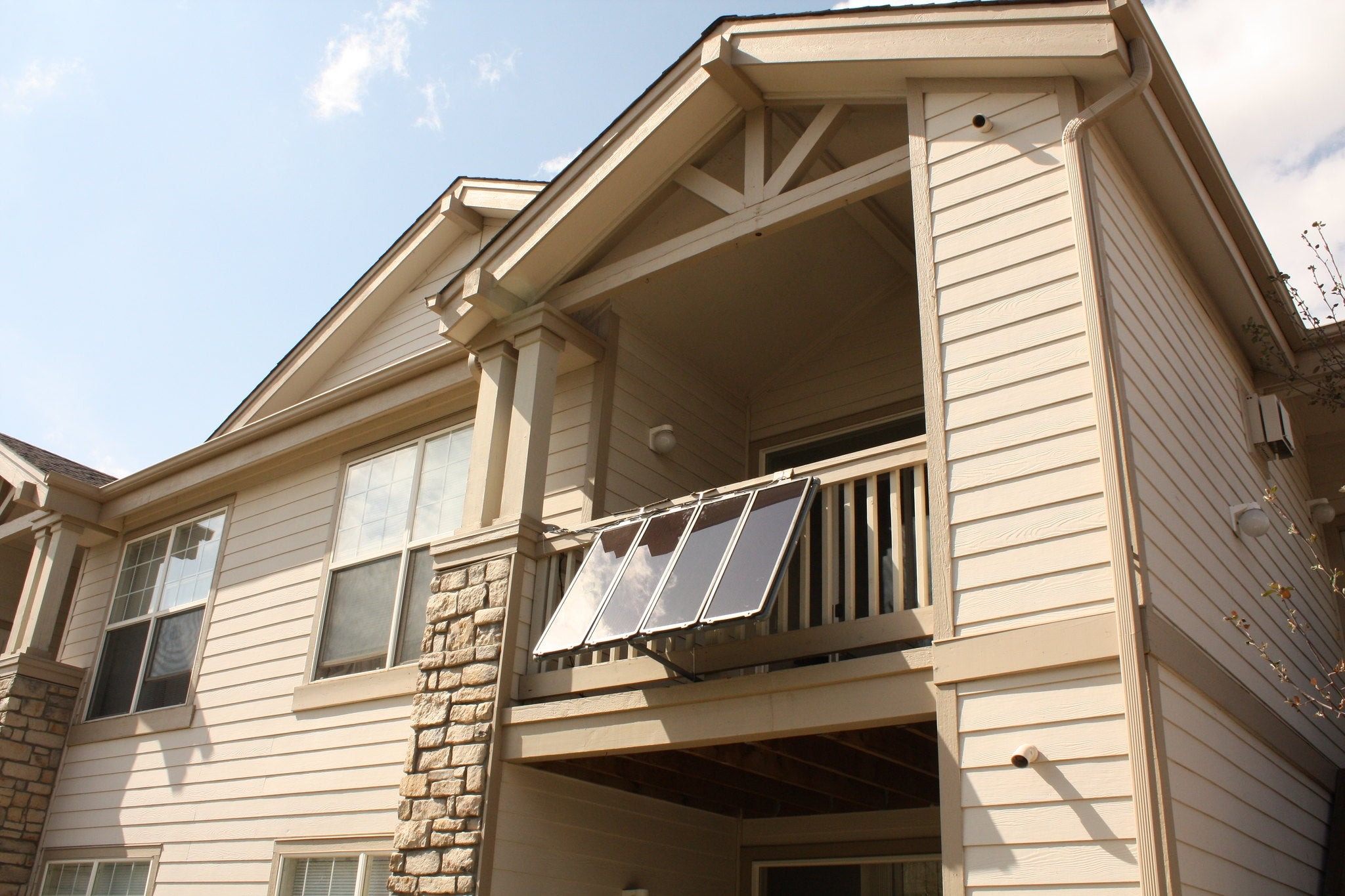
There are many ways that renters can generate their own solar energy. Here, solar panels have ingeniously been attached to a balustrade. Image credit: Robert Tadlock via Flickr
3. Join a community solar project
Depending on where you live, there may be a community solar project you could join. A community solar project allows people in a specific community or area to come together and purchase a solar system as a group.
Instead of installing your solar panels on your own roof or backyard, you help fund a utility-grade installation. The power produced by the system is exported to your local electric utility.
Virtual net metering is then used to reduce your utility bill, based on how much you contributed to the project.
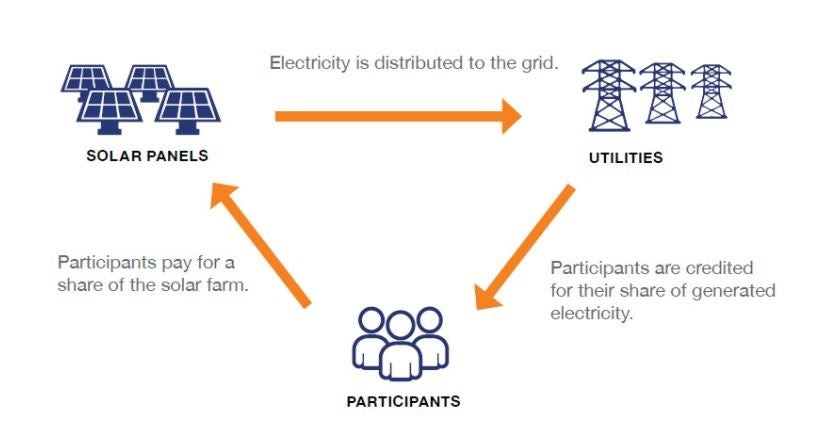
How community solar works. Image credit: United States Environmental Protection Agency
This allows you to benefit from solar savings even if you don't own a property. As long as you stay in the same general area of the community solar project, you benefit from the savings. This gives you greater flexibility and allows you to move into a new rental property as needed.
Because you're going in with other households and businesses to get a much larger system, you can benefit from economies of scale. Installation efficiencies and lower equipment costs mean that large-scale solar projects can generate power more cheaply than a household system.
A major disadvantage of community solar is that it can be hard to find. Only a few states allow them, and even there it can be hard to win project approval.
Learn more: Community solar vs home solar - which is better?
4. Buy green power for your home
If you can’t directly generate solar power for your living space, you can always purchase green power.
Green power, according to the EPA, is the subset of renewable energy that confers the greatest environmental benefits.
In case you’re wondering, yes, the EPA includes solar as a green power source.
There are two ways to do this:
A. Buy green power directly from your utility
Most utilities offer green power options to their homeowners.
Under these ‘green’ rate plans (also known as ‘green pricing’), consumers are guaranteed that a certain portion, if not all, of their energy usage is sourced from certified renewable energy sources.
You won’t save any money by purchasing green power; in fact, green power options usually cost a few cents more than standard electricity rates. But this option does offer consumers peace of mind that they have reduced their carbon footprint.
B. Purchase RECs
Another option is to buy Renewable Energy Certificates, commonly known as RECs.
A REC certifies that the power you purchased for your home comes from a green, renewable source. Each REC represents 1 MWh of energy, while the average household uses about 11 MWh of electricity a year.
Your utility probably uses RECs to offer its green rate plans, but you can also buy RECs directly through certified retailers.
Here’s a video by the US Environmental Protection Agency that explains how RECs work:
Going solar in an apartment or rental is very doable
Many people assume that if you want to go solar, you have to install solar panels on the roof of your house.
However, as we’ve laid out in the article, it is entirely possible for renters and apartment owners to benefit from solar as well.
You can opt for a portable solar panel system - which can be used anywhere there is sun - or you could pay for a share of solar electricity produced elsewhere using innovative models like community solar, utility green power, and RECs.
More solar power means less power from fossil fuels. However you choose to go solar, you will be making a difference to the environment - possibly even saving on energy costs in the process.
Zeeshan is a solar journalist who has long been passionate about climate issues and developed a deep interest in solar power after witnessing its successful adoption in Australia. He has previously worked as a journalist for a major news organization, covering energy, climate, and environmental stories, among other topics. He also served as an organizer for the Pakistan Youth Climate Network, an advocacy group aimed at raising climate awareness...
Learn more about Zeeshan Hyder